Docs
Doc / Compare / VPN vs. OmniEdge
VPN vs. OmniEdge
What is the difference between OmniEdge and VPNs?
A virtual private network (VPN) extends a private network across a public network and enables users to send and receive data across shared or public networks as if their computing devices were directly connected to the private network. Traditional VPNs require a central server that all traffic routes through, creating potential bottlenecks and single points of failure.
OmniEdge is a peer-to-peer mesh VPN built in Rust, using the WireGuard-based OmniNervous protocol. Instead of routing through a central server, OmniEdge creates direct encrypted tunnels between devices, building a virtual network where all nodes connect directly to each other.
Benefits of OmniEdge vs. Traditional VPNs
With OmniEdge, you:
- No central server required - Direct peer-to-peer connections eliminate bottlenecks
- No VPN gateway needed - Connect branches and remote workers without dedicated hardware
- Lower latency - Direct P2P connections with only ~0.3ms encryption overhead
- Industrial-grade stability - Cpk 2.92 (6-Sigma) validated through 50-run testing
- Better throughput - Up to 484.7 Mbps vs 344.1 Mbps raw internet (+140% improvement)
- Advanced NAT traversal - 99%+ success rate with automatic relay fallback
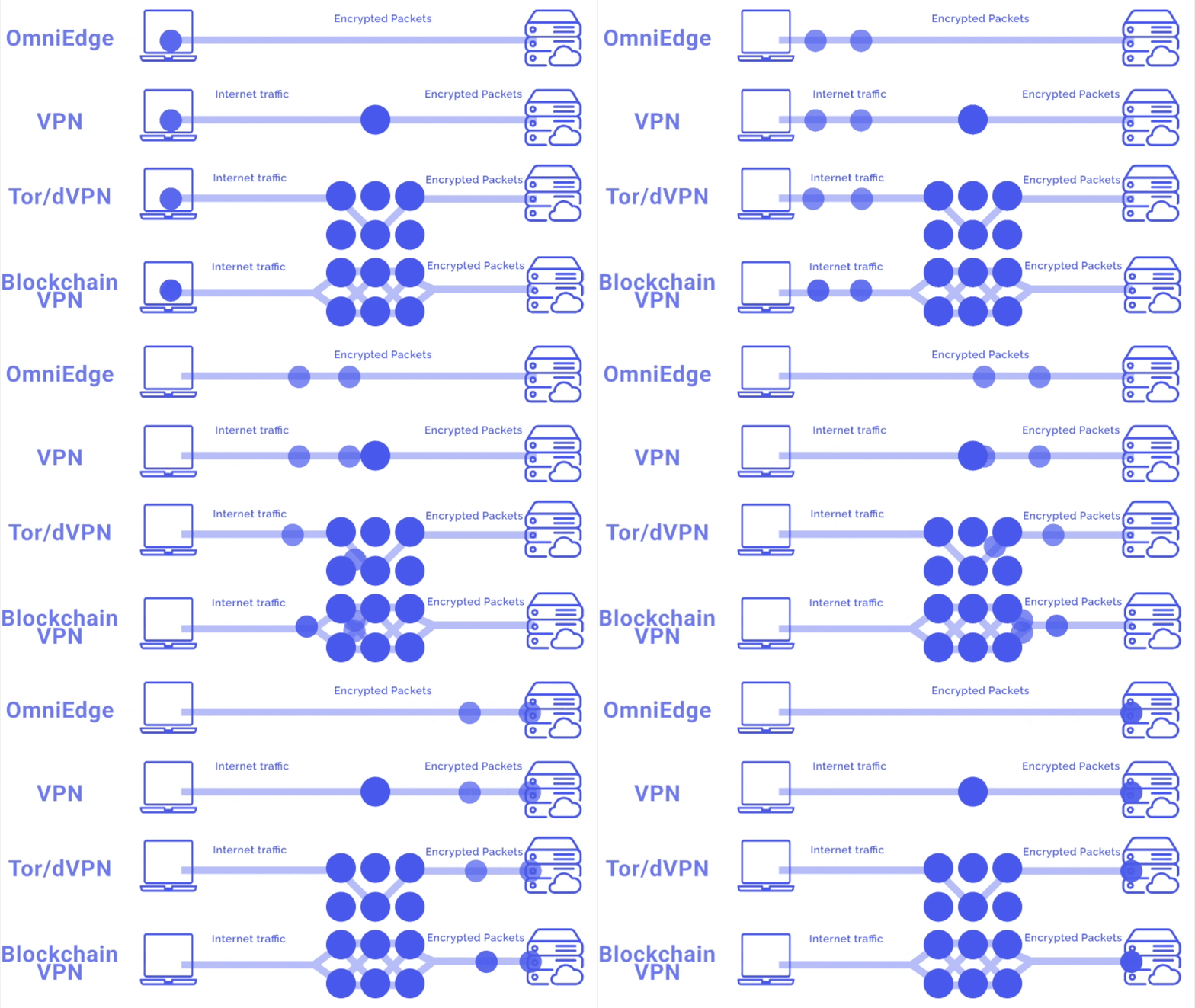
Architecture Comparison
| Aspect | Traditional VPN | OmniEdge |
|---|---|---|
| Topology | Hub-and-spoke (all traffic through server) | Peer-to-peer mesh |
| Single point of failure | Yes (VPN server) | No (decentralized) |
| Latency | Higher (server relay) | Lower (direct P2P) |
| Scalability | Limited by server capacity | Scales with nodes |
| Self-hosted option | Requires infrastructure | Yes (nucleus mode) |
Basic Information
| Software | Version | Language | Protocol | Linux/Windows/macOS | iOS/Android |
|---|---|---|---|---|---|
| OpenVPN | 2.6.x | C | Custom TLS | Yes/Yes/Yes | Yes/Yes |
| WireGuard | 1.0 | C/Rust | Noise | Yes/Yes/Yes | Yes/Yes |
| OmniEdge | 2.2.1 | Rust | OmniNervous (WireGuard-based) | Yes/Yes/Yes | Coming Soon |
Networking Features
| Software | TUN/TAP | Auto Meshing | NAT Traversal | Exit Node | Relay Fallback | Plugin System |
|---|---|---|---|---|---|---|
| OpenVPN | Yes/Yes | No | Partial | No | No | No |
| WireGuard | Yes/No | No | No | Manual | No | No |
| OmniEdge | Yes/Yes | Yes | Yes (STUN/TURN) | Yes | Yes (automatic) | Yes (WASM) |
NAT Traversal Comparison
| Feature | OpenVPN | WireGuard | OmniEdge v2.x |
|---|---|---|---|
| STUN Detection | No | No | Yes |
| UDP Hole Punching | No | Manual | Automatic |
| Symmetric NAT Support | No | No | Yes (relay) |
| UPnP/NAT-PMP | No | No | Yes |
| IPv6 Dual-Stack | Yes | Yes | Yes (Happy Eyeballs) |
Security Features
| Software | Encryption | Key Exchange | Forward Secrecy |
|---|---|---|---|
| OpenVPN | AES-256-GCM (OpenSSL) | TLS 1.3 | Yes |
| WireGuard | ChaCha20-Poly1305 | Noise_IK (Curve25519) | Yes |
| OmniEdge v2.x | ChaCha20-Poly1305 | Noise_IK (Curve25519) | Yes |
Performance
Validated through 50-run longitudinal testing:
| Metric | OmniEdge Tunnel | Raw Internet | Notes |
|---|---|---|---|
| Latency | 54.69ms | 54.36ms | +0.3ms overhead |
| Latency Stability (Cpk) | 2.92 (6-Sigma) | 6.47 | Industrial-grade |
| Throughput | 484.7 Mbps | 344.1 Mbps | +140.8% improvement |
| Jitter (StdDev) | 0.057ms | 0.026ms | Bounded, predictable |
Throughput Comparison
| Test Environment | Bandwidth |
|---|---|
| Native Network | 4970 Mbit/s |
| WireGuard | 3810 Mbit/s |
| OmniEdge v2.x | 3470 Mbit/s |
Note: Tests performed between 2 AWS m5.large instances. OmniEdge provides near-WireGuard performance with additional mesh networking and NAT traversal features.
Use Cases
| Use Case | Traditional VPN | OmniEdge |
|---|---|---|
| Remote access to office | Good | Excellent |
| Multi-site connectivity | Complex (requires gateways) | Simple (P2P mesh) |
| IoT/Robot fleets | Poor (latency, NAT issues) | Excellent |
| Federated learning | Complex setup | Built-in support |
| Air-gapped environments | Requires infrastructure | Self-hosted nucleus mode |
OmniEdge v2.x Features
- Complete Rust rewrite - Memory-safe, high-performance
- WireGuard-based protocol - Modern cryptography (ChaCha20-Poly1305, Curve25519)
- WASM Plugin System - Extend functionality with sandboxed plugins
- Three operating modes: Edge (client), Nucleus (server), Dual (both)
- Cross-platform: Windows, macOS, Linux (x86_64, ARM64, RISC-V)
- Desktop app: Tauri v2 with system tray integration
If you have more questions, feel free to discuss.
On This Page